Saturday, April 25, 2015

Finally Farming!


We planned to start planting for the CSA earlier this week but the ground was just too cold and wet.

It's always tempting to start before we have the right planting conditions but by now we know better. Planting in wet soil compacts the soil and creates less than desirable conditions for plants to grow. 

We finally were able to make some progress today. We planted peas - sugar snap peas and snow peas - and prepped the ground for potatoes and onions. Progress!

Saturday, August 23, 2014

Two tips for your CSA flower picking


We are finally getting a nice quantity of flowers in our CSA fields. Our members enjoyed picking some beautiful bouquets today!

We spend so much time communicating about our CSA vegetables, I thought I'd do a quick blog post on some ideas I saw in the fields today.

First, Debbie Wickham's bouquet from this morning. Do you see what is making her colors pop? That's kale! Red kale to be precise. So consider cutting a few leaves of red kale for your bouquet. Kale is on u-pick pretty much all season long.


And this is Tracy's bouquet. Here's a transporting tip: bring a tall travel coffee mug filled with water to upick. When you're done picking, put the flowers in the cup, and put it in the cup holder of your car. No spilling!

Looking forward to lots more beautiful bouquets this year!

Monday, January 27, 2014

New addition: The Grab & Go Share

For the past two years, we've conducted surveys of our CSA membership, and generally the feedback has been extremely positive. That is why we will continue to offer our full and biweekly shares without substantial changes in 2014. (Information on those shares can be found on our website.)

Of concern to us, though, was feedback from folks who tell us they have been overwhelmed by the quantity of food they receive in their full or biweekly shares. Some have small families; others have limited time for food preparation.

In response to that feedback, we are offering a new share: The Grab & Go Share. Here's how it differs from our full and half shares:
- Pick up is every week (18-20 weeks) on Tuesdays.
- Smaller size: 6-10 items per week, with an emphasis on the more commonly used crops. This makes it a good size for couples, singles and people who are busy.
- Prepacked for convenience: It will be ready for you to take home in a collapsible, reusable container. Just pick it up, take it home, and return the container the following week.
- Choose pickup at one of three locations:  Wickham Farms; the UPS Store at 300 Hylan Drive in Henrietta (across from Marketplace Mall); the UPS Store at 106 Cobblestone Court in Victor (across from Eastview Mall).
- The price is $395 for the 18-20 week growing season.
- U-pick flowers, herbs and bonus crops are not included, but you may add it for $125 for the entire season.

This share is also available for delivery to businesses or to a central area in a neighborhood. If you would like for Bill Wickham to speak to your business or neighborhood group regarding this share, please email us at office@wickhamfarms.com.

For more information about the new Grab & Go Share, visit our website. If you have questions, please feel free to email us at office@wickhamfarms.com.

Tuesday, October 29, 2013

Creamy Sorrel Soup

We're behind in posting! In the off season, I hope to catch up on posting all the recipes we've cooked for the CSA in order to give our members an online resource for recipes.

In our weekly recipes, we do our best to highlight ingredients that may be unfamiliar to our members. This week's recipe highlighted sorrel, in addition to the onions, carrots, celery, potatoes and thyme that all were in this week's share. This recipe was a huge hit -- the sorrel added a fresh, lemony tang to the soup.

One recipe makes about enough for four; if you want to fill a crock pot, you'll probably need to triple it.


Creamy Sorrel Soup
Adapted from this recipe on Food52.com
2 tablespoons unsalted butter
1 cup yellow onion, small dice
1/4 cup carrots, peeled and diced small
1/4 cup celery, washed, trimmed and small dice
2 cups starchy potatoes (any of the CSA potatoes will work well), small dice
1/3 cup basmati rice
4 cups vegetable broth
1 cup cream
2 1/2 cups sorrel, washed, spun dry and chopped
2 teaspoons fresh thyme, minced
Salt and fresh ground pepper

Place a large Dutch oven or pot over medium heat. Add the butter and as it melts add the onions, carrots and celery. Season them with ½ teaspoon of salt and several grinds of fresh pepper.

Let the vegetables sweat until tender, then add the potatoes, rice and vegetable stock. Bring the soup to a boil then reduce the heat to a simmer.

Cook until the rice and potatoes are tender, 20 and 30 minutes. Once they are tender, add the cream, sorrel and fresh thyme. Heat the soup through and until the sorrel is wilted. Taste, adjust seasonings (it will probably need salt) and serve.

Tuesday, July 2, 2013

Salsa Chicken

Looking for a way to use up your CSA greens? Here's a simple and easy recipe from CSA members Denise and Art Cuestas for Salsa Chicken. You can use cilantro from the herb garden this week!
 
Salsa Chicken
1 Family Pack of Wegman's (or other brand of your choice) boneless/skinless chicken thighs (Bone-In works very well too)
1 15.5 oz  Salsa (medium) - they use the Wegman's organic brand, in the Latin Foods section
Chopped Cilantro
Cut mixed greens of any variety
Rice of your choosing
Taco seasoning (optional)
Grated cheese for garnish.

Place chicken in bottom of slow cooker, then pour 3/4 bottle of salsa over the chicken.  On a low setting, it usually takes about 3 hours to cook.  On a high setting, about 2 1/2 hours or so.  the best way to check to see if it is finished is to check a few times as it is cooking.

Prepare rice (quantity of your choice) while chicken is cooking.

When the chicken is fork tender, it should be finished.  Mix in the rest of the Salsa, and if you like some taco seasoning of your choice.  Add chopped cilantro to your taste.

On dinner plates or pasta bowls, place a large helping of a variety of cut greens (any kind).  Spoon as much or as little rice on top of the greens.  Top the greens with the chicken salsa mix from the slow cooker. Top with a little more fresh cilantro and grated cheese for garnish.

Thursday, June 13, 2013

Rain, Rain Go Away

A wise old farmer by the name of Don Wickham (Bill's Dad) has a saying:

"A dry year will scare you to death.
A wet year will starve you to death."

There seems to be a misconception that a lot of rain is good for farmers.
The reality is that we'd like about an inch of steady rain each week.
In the past week (Thursday to Thursday), we've gotten 4.25 inches (so far).

 Here are a few snapshots of what too much rain has done to some areas of our fields.


The picture above shows what the erosion from too much water has done to our early planting of beans. Thankfully, the beans at the end of the row -- in the top right corner of the picture -- are looking good. Our later plantings of beans were not affected. That means we may have a smaller quantity of beans available early in the season.


 This is what too much rain has done to some of our spinach. As Bill says, it is toast.


The spinach in the bottom of the picture is dead. Glad there's some further down the row that looks green. We planted a large quantity of spinach this year, which will help the situation.

Another complication of the rain is that we have not been able to do any field work this week. When the ground is wet, we cannot plant or weed. We plan for successive weeks of planting to give our CSA members a steady supply of crops. We were not able to complete any of this week's planting schedule.

 At this point, the rain is a challenge, not a disaster. But we will be most relieved if we have a dry weekend!

Thursday, May 16, 2013

Thoughts on Splitting a CSA Share

Dividing a share can be a great way to experience a CSA!
Although we’re still about a month away from our first harvest, it’s a good time to do some thinking and planning for the upcoming season. If you are splitting a share for the first time, you may want to have a conversation with your partner to make sure you have a common understanding about the upcoming harvest.

Are we paid up?
We send invoices to only the first/primary name on the membership form. It is up to that primary member to either collect from the other member, or remind the member to pay their share to our farm. Your account will need to be paid in full to participate in the first harvest distribution.

How will we pick up our share?
We ask that members take the entire weekly share in one visit to the farm, or in a single delivered box. At the farm, you may not take a partial or half share. There are a couple of ways to handle this:
1.  Pick up your share together and divvy it up then. We are fine with that happening at the farm, as long as it doesn’t hold up the line for our other members.
2.  Alternate pickup weeks. The advantage of this arrangement is that you only have to deal with pickup half the time, and you do not have to plan your pickup time around another member. We are sympathetic to our members who are waiting around at pickup while his/her partner is delayed!

How will we divide our share?
Keep in mind that every share is the same, regardless of whether or not the share is being divided. Some of the contents of the share may not split equally or easily. As an example, you may get 1 watermelon, 5 carrots, 5 tomatoes, and/or 1 head of cabbage. It will be up to you to decide how to divvy it up.

When Tracy, our director of marketing, joined her first CSA program, she divided a share with her friend, Jackie. Here’s how they worked it out.

Tracy and Jackie alternated picking up the weekly share and taking it home. On your pickup weeks, it was up to you to divide any amounts that didn’t divide easily.

As an example with the share above, Tracy might divide it this way:
- She would take 2 carrots and give Jackie 3, and then take 3 tomatoes and give Jackie 2.
- She would cut the cabbage in half and the watermelon in half, so that they each got half.

On Jackie’s week, she might decide it differently. She might give Tracy the whole cabbage and keep the whole watermelon.

Once the pickup person was done dividing the share at home, she’d leave it in a bag on her front porch for the other person to pick up at her convenience.

 3. Is everyone getting communications?
This year, we’ve added space on our membership form for information about a second member. That way, we can send emails to both members. We also have another phone number to call if the share is not picked up (we will make courtesy reminder calls the first few weeks). If you would like additional email addresses on our email distribution list (such as for spouses), please feel to call or email Tracy or Mary at office@wickhamfarms.com or 377-3276.

Questions about splitting shares? Feel free to email Tracy at office@wickhamfarms.com.

Tuesday, April 23, 2013

Eating With The Seasons - Thoughts from Claire Burdick

Meet Claire Burdick, our director of field operations. Claire shares her thoughts on the challenges and benefits of eating with the seasons.

Claire pruning grapevines in March.
Like many folks who have CSA memberships, I have a great fondness for eating local foods. From June through October that generally means taking the kids "shopping" in our large back yard garden. Over the years we've expanded our garden to the point that most of our fruits and vegetables come from this most local of places. The learning curve has been steep, and at times I've encountered difficulties that I hadn't anticipated. The biggest of those was undoubtedly learning to eat with the seasons -- that is, accustoming myself and my family to eating and appreciating what the Earth has to give us, when it is offering, without resentment! I have a feeling that some CSA members might share in these difficulties as it can be a bit overwhelming to find yourself with bucket loads of greens in the spring, or a trunk full of tomatoes in the summer. Maybe sharing my journey to becoming season-savvy can offer some help!

Before I became what my friends and neighbors lovingly call a "hardcore" gardener, I'd shop each week at the grocery store for all of our favorite fresh fruits and vegetables. I prided myself on a cart that was always well balanced- cabbage, peppers, broccoli, apples, tomatoes, sweet potatoes, grapes... you know what I mean. The only time I ever gave thought to the fact that a particular food was out of season was when it drastically affected the price ($4 per pound for asparagus in October, you must be kidding me!?). So as my garden grew I found myself in an unfamiliar situation- for instance during the summer of 2008 I probably uttered the phrase "please, PLEASE, no more greens" at least a hundred times. I'd put so much time and effort into planting, tending, and loving those vegetables that each head of lettuce practically had its own name. But when the harvests started really coming in I felt-- I don't know-- over it.

Claire planting seedlings with Debbie Wickham.
See I had been buying kale, spinach, and lettuce each week at the store, all winter long. So even though I now had the freshest possible vegetables in almost unlimited supplies, they just didn't seem that special. I hid that feeling from everyone, ashamed that I could be anything less than thrilled with my own hard work. Finally I spilled the beans, so to speak, to my husband, who admitted he felt the same way. We decided then and there to eat with the seasons. Even if that meant no more fresh tomatoes in January, or eating frozen greens through the winter so that the first bite of fresh spinach in the spring was *that* much more meaningful. We do treat ourselves to fresh produce throughout the winter, but we try to make it a special treat instead of a predictable weekly grocery list.

It was only when we made this decision that it all started to click for me. I finally realized that eating local isn't just about supplementing the grocery store with a few fruits and vegetables here and there, but rather embracing all of the peculiarities of the growing season and what it gives us. I realized that there were so many leafy greens in the spring because our bodies had been surviving on calorie dense foods all winter, like potatoes, squash, grains, meat etc. Dark leafy greens are some of the most concentrated forms of nutrients, you get A LOT of bang for your buck out of them. They are low in calories but high in everything our body craves after a long, dreary winter. In other words all those salad greens that grow in the spring are nature's way of telling us to replenish and revitalize ourselves. The Earth is providing for us what we need to gear ourselves up for a labor-intensive warm season. We truly need those greens, even if we start to resent all those salads by the 4th of July!

After we've feasted on greens, the warm weather hits. We start to go outside more, exert ourselves more, and dehydrate a lot more quickly. It is at this point in the season that watery foods start coming into full swing. Berries, tomatoes, cucumbers, zucchini, watermelon... all of these have LOADS of water. We rarely stop to think about why it is that the watery-est vegetables and fruits tend to grow during the driest times of the year. It's simply that unrelenting mother nature reminding us to stay hydrated! Water is, after all, the thing with which our bodies cannot survive. So eat those watery foods in the summer, and just when you feel like you can't eat another tomato or cucumber- eat a couple more, they will be gone soon :)

Claire checks on potatoes in July.
That brings us to the fall- it's not just my favorite season but it's also the busiest here at Wickham Farms. The pumpkins, apple cider, and cool crisp air come just in time to save us from the dog days of summer. It's also when the high calorie fruits and vegetables start to make their presence known. Potatoes, apples, winter squash, root vegetables- all of these favor the cooler fall temperatures, and they conveniently all have long storage lives as well (as if they are meant to last us through winter). We all know it takes a good source of nutritious calories to make it through the cold winters in Rochester!!

At Wickham Farms CSA we work very hard to provide our customers with the best possible variety throughout the growing season, and I think we do a pretty good job! Still, if you find yourself feeling a bit salad-fatigued around by the beginning of July, try to remember that those watery summer treats are just around the corner!

Wednesday, January 30, 2013

CSA Member BBQ Dates

Last year, we had such fun at our Wickham Farms CSA Member BBQ! We regretted that some of our members couldn't join us due to vacations and other conflicts. This year, we're trying to give more members a chance to attend. We're setting the dates earlier in the season, and we're giving members two dates to choose from: Tuesday, July 30 and Wednesday, August 14. We will be sending information via our CSA email newsletter, but wanted to promote the dates well in advance!

Thursday, January 10, 2013

Sneak Peek: Garlic!

Mary Pat, Claire and Amy planted garlic early in November.
Although we are months from planting most of our CSA crops, one crop is already in the ground -- garlic! Garlic is unusual in that it's planted in the fall. The garlic scapes will come up in early summer, likely within the first few weeks of the season (mid June is typical). We will pull the bulbs around the end of July or early August, but we will to wait for the tops to start to die off before we distribute them. (Unlike onions, we won't wait for the tops to completely die back.)

If you haven't had garlic scapes before, they are delicious! Garlic scape pesto is probably the most popular use for garlic -- there are quite a few good scape recipes floating around on the internet. You may want to bookmark a few possibilities for spring! Another alternative is to boil the scapes for just a couple minutes then sautee them as you would asparagus. They are quite tasty like that too.

Some interesting tidbits about garlic:

We planted under plastic
to control weeds.

~ Although they are planted the previous season, they are one of the lowest-maintence vegetables. Deer don't eat them, there are very few diseases to which they are susceptible, and they actually benefit many other plants by repelling harmful insects. The biggest concern for a large-scale grower is keeping weeds at bay, because garlic that has been crowded by weeds will not grow as large. That's why we plant ours under plastic mulch!

~ Garlic is a super food that supports digestive health, heart health, and boosts the immune system all at the same time.

~ Although it is common to see minced garlic packed in oil at the grocery store, that is not a safe way to store garlic at home. The oil provides an ideal growing environment for contaminants like botulism.

- Garlic is best stored with the bulb intact, in a cool and dry place with little sunlight. Claire, our chief grower, puts her garlic in large brown-paper bags and store them through the winter in her downstairs laundry room.

~ The variety that we've planted at the farm are all hard-neck varieties. The benefits to hard-necks are that they make scapes (so it's like getting 2 crops from one plant), They also typically have a better flavor and aroma. The only down side to hard neck varieties is that they generally have a reduced storage life compared to soft-neck varieties. Properly stored, they should be good until December or so.

Tuesday, December 4, 2012

Our story of 2012

This was given to the Wickham Family as a gift from several staff members. (It takes a minute or so to load.)


Build your own high-quality photo books at Shutterfly.com.

Sunday, August 12, 2012

Odds and Ends Dinner Pancake

Odds and ends dinner pancake. Try substituting extra veggies that you've been meaning to use!

1 medium onion, diced
2 small heads of broccoli, cut into very small pieces
3 leaves of kale, ribs removed and roughly chopped
2 carrots, diced
2 tbs olive oil, plus more for the pan
1 cup corn meal
3/4 cup whole spelt flour (or any whole grain)
3 eggs
1/2 cup chicken stock
Salt and pepper to taste

Over medium heat, sauteé the carrots, kale, broccoli, and onion in the 2 Tbs olive oil for about 7 minutes, until softened a bit.

Mix the sauteed veggies with all the other ingredients in a mixing bowl, it should be the consistency of pancake batter (plus veggies, of course).

Heat the extra oil over medium high heat in a non-stick pan, use just enough oil to coat the surface of the pan, and gently pan fry 3/4 cup of batter at a time. Allow to cook on one side undisturbed for 4 minutes, flip and cook for an additional 3 minutes.

We ate them warm over a bed of baby spinach, with a spicy pepper sauce on top. Very yummy and versatile!

Friday, July 13, 2012

What's growing this week...

We harvested the first of our green beans this week. Yellow beans aren't far behind.

We're seeing a lot of deer damage to our beans. See all those sticks pointing straight up? They should have flowers and/or beans on them. The deer aren't killing the plants but they are reducing and delaying the harvest.

Beets are looking great! We will most likely harvest and distribute next week.
We've planted a lot of broccoli. We distributed our first of it this week. It will likely continue next week (and beyond).

Broccoli is interesting because plant produces one large primary head. On this one, where you see the grayish cut, the primary head has been harvested. Then, we get more shoots, which are smaller. Some people prefer the smaller shoots because their stems are not as thick.


Cheddar cauliflower seems to be coming along well -- so far. Cauliflower is temperamental, which is why a lot of local CSAs don't grow it. It prefers consistently cool temperatures, which is why almost three fourths of commercial cauliflower is grown in the coastal valleys of California. The other disadvantage is that one plant produces only one head, unlike broccoli. We are giving it our best shot, though, because we know a lot of people like it.

Concord grapes look beautiful so far. Because these vines have not been pruned for years, we are not sure how productive they'll be and how much we'll be able to offer our CSA members.

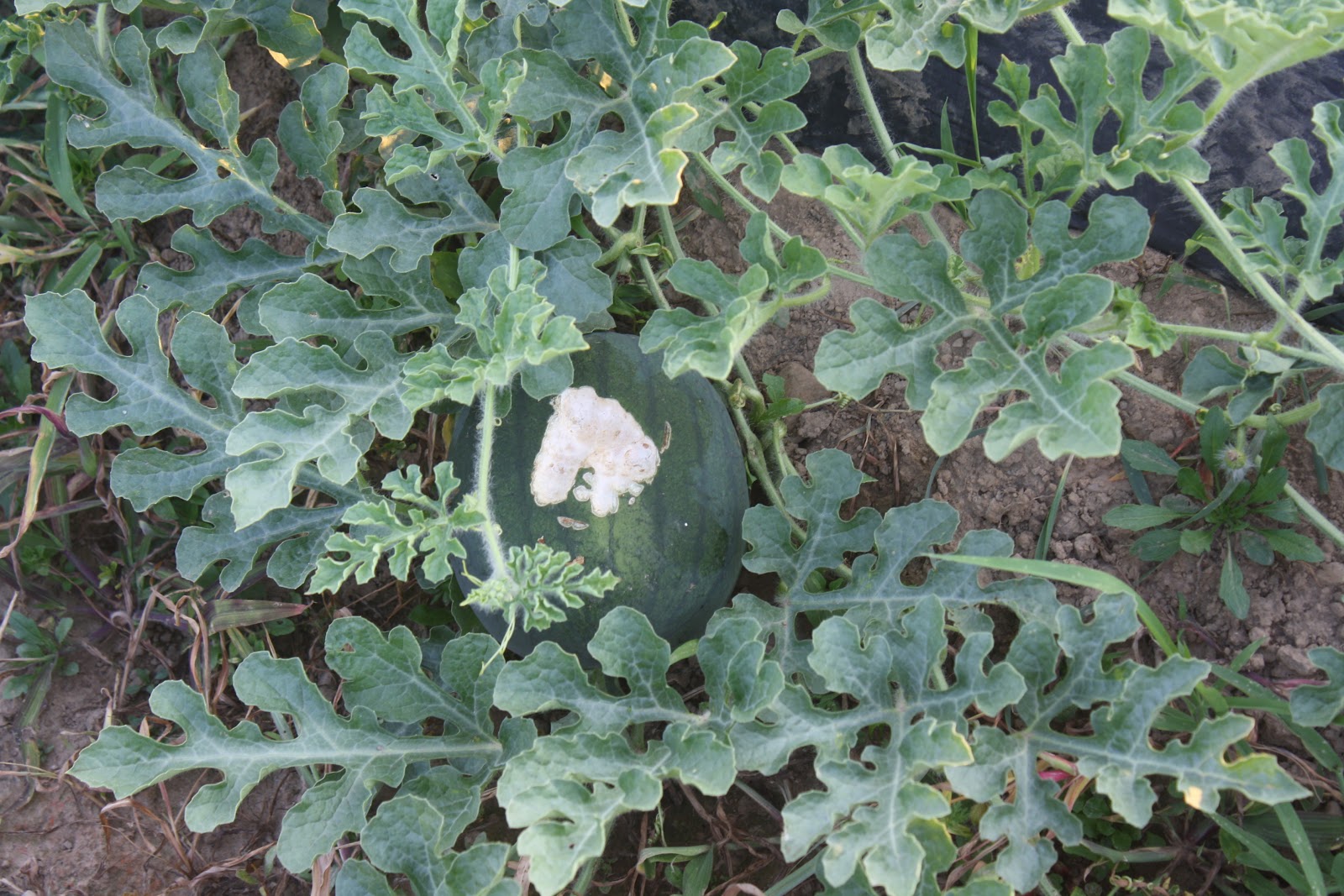
Because of the heat, this should be a good year for melons. We re growing smaller "Sugar Baby" melons. The smaller melons are the most practical ones to grow in our climate because melons need lots of long, hot days to grow. We usually  don't have as many of those days as the bigger melons need. This year has been very different, though! We wish we knew that back during the cold month of April!

We've seen some deer nibbles on our melons, but a bigger concern is crows. Some growers encounter serious trouble with crows in watermelons, and not much can be done in terms of control. They wait until they are just ready to be harvested and then start pecking away. We have seen some crows in the field -- we're just hoping they aren't savvy ones!
We're starting to see baby peppers. We're still weeks from being able to harvest them.
Pattypan squash -- two colors of them -- look good, and should be ready next week.

Summer squash and zucchini will continue next week.
We've planted sunflowers for our members to enjoy. We have just one in bloom right now. It looks a little lonely.
A lot of people have been asking about tomatoes. We understand -- we love them too! They are coming along but are still a few weeks away from being ripe.

Wednesday, July 11, 2012

Shares, weeks 1-5

WHEW!!! We've survived four weeks of harvesting and distribution, and we've entered week five. It's hard to believe that we're almost a quarter of the way through the CSA. We're getting a lot of positive feedback and constructive suggestions, and we've already made a number of adjustments along the way. Here's a quick recap of weeks one through five.

Week 1 was, as expected, a fairly small harvest as we're just beginning to harvest. It included some beautiful tender lettuces, kale, mizuna, radishes, spinach and rainbow Swiss chard. Some hungry deer made our sugar snap peas a bit later than expected, but everyone got a handful -- enough to nibble on the way home!
Week 2: Everyone was excited to see plentiful snow peas! They are definitely popular among our members. We also harvested our first arugula and red Russian kale. In addition, we had various lettuces, mizuna, radishes, spinach and spring onions. We swapped with another local farmer who uses a high tunnel farming technique to get some early zucchini and squash. We also started to cut some herbs and wildflowers. People with cats especially enjoyed the catnip!

Week 3 brought our first harvest of kohlrabi! It was a first-time veggie for a lot of members. Early-season greens continued; to avoid palate fatigue, we allowed members to weigh (1.75 pounds -- that's a lot of greens) their choice of greens from arugula, tatsoi, mizuna, kale and red kale. Leaf lettuce greens continued, as did snap and snow peas.
In week 4, we continued to offer a choice of greens, including arugula, tatsoi, mizuna, kale and red kale. Leaf lettuce continued, as did sugar snap peas, snow peas, kohlrabi and radishes. We also offered yellow squash, which was not harvested in time to make our picture.

Week 5 began the transition to some of our popular summer crops -- broccoli, green beans and cabbage! We also had zucchini, yellow squash and the tail end of snow peas. We had three kinds of lettuce to choose from (2 heads total). Our choices of cooking greens continued, with a choice from arugula, tatsoi, mizuna, kale, red Russian kale, and Swiss chard. Our herbs really came on this week, with several available for cutting.

Saturday, June 9, 2012

Harvest Pick-up Begins Monday!

We are so excited to start harvesting! Our member pick-up begins on Monday. Here's a sneak peak of what's coming.

Kale 

Radishes -- these are Easter Egg radishes. See how they are shaped like Easter eggs?

Lettuces will be small "baby" lettuce.

Rainbow Chard

More baby lettuces

Spinach. Use the small "baby" leaves for salads. Use the larger leaves in cooking.
Mizuna. You can use this raw or cooked.
If you haven't received your email with your pick-up dates and times, please contact us at the farm as soon as possible!

Friday, June 1, 2012

Rainy Days & Plastic

Starting the weekend with a rainy day is a little gloomy, but after a hot week our crops really needed the rain! We now have some of every kind of crop planted -- but there's still lots more planting to do. Weeding, too!

Every crop that we're planting with black plastic is now in the ground. That includes peppers, tomatoes and melons. The plastic controls weeds and also provides extra heat to the plants. Laying the plastic over a former vineyard has been a challenge -- those old vines keep getting in the way. We're glad to have this particular task behind us.

So far we're on track for our first crop distribution in mid-June.

Thursday, May 17, 2012

Planting Seedlings

Purple cabbage seedling
For the past couple of weeks, we have been planting seedlings, which were started in the greenhouse. Some crops will only be planted from seedlings. For other crops, we will plant both seedlings and seeds to extend the time when they are available. The first weeks will come from plants grown from seedlings, and the following weeks will come from the plants grown from seed.

Paul and Debbie planting on the water wheel planter
If you've ever planted seedlings or small plants at home, you know that getting on your hands and knees, digging a hole and putting in the plant takes time (and is hard on your back). With more than 2,000 seedings to plant, we needed a more efficient process. That's why we invested in a used water wheel planter, which has been a godsend for planting seedlings. The water wheel, which you can see between Paul and Debbie, makes a hole and fills it with water, and then Paul and Debbie insert a plant. As the water is absorbed by the soil, it pulls the plant into the hole.

Yep, that's muddy.

Debbie says that the process is murder on a manicure, but all the leaning and twisting is giving her obliques a great workout. Maybe we could do a "get rid of your love handles" exercise class and have people help plant seedlings on the water wheel planter!

Hoeing the rows
Once the seedlings are in the ground, Paul and Debbie go down the rows with a hoe to make sure the roots are fully covered with soil.

We have planted broccoli, cabbage, cauliflower, Swiss chard and other plants in this manner -- more than 2,000 seedlings in all. They are coming along, but the cool weather has resulted in them growing more slowly than we had hoped. Our best estimate is that our first pick-up day will be in mid-June, but that will depend on the weather. The plants need warm weather to grow!