Thursday, May 16, 2013

Thoughts on Splitting a CSA Share

Dividing a share can be a great way to experience a CSA!
Although we’re still about a month away from our first harvest, it’s a good time to do some thinking and planning for the upcoming season. If you are splitting a share for the first time, you may want to have a conversation with your partner to make sure you have a common understanding about the upcoming harvest.

Are we paid up?
We send invoices to only the first/primary name on the membership form. It is up to that primary member to either collect from the other member, or remind the member to pay their share to our farm. Your account will need to be paid in full to participate in the first harvest distribution.

How will we pick up our share?
We ask that members take the entire weekly share in one visit to the farm, or in a single delivered box. At the farm, you may not take a partial or half share. There are a couple of ways to handle this:
1.  Pick up your share together and divvy it up then. We are fine with that happening at the farm, as long as it doesn’t hold up the line for our other members.
2.  Alternate pickup weeks. The advantage of this arrangement is that you only have to deal with pickup half the time, and you do not have to plan your pickup time around another member. We are sympathetic to our members who are waiting around at pickup while his/her partner is delayed!

How will we divide our share?
Keep in mind that every share is the same, regardless of whether or not the share is being divided. Some of the contents of the share may not split equally or easily. As an example, you may get 1 watermelon, 5 carrots, 5 tomatoes, and/or 1 head of cabbage. It will be up to you to decide how to divvy it up.

When Tracy, our director of marketing, joined her first CSA program, she divided a share with her friend, Jackie. Here’s how they worked it out.

Tracy and Jackie alternated picking up the weekly share and taking it home. On your pickup weeks, it was up to you to divide any amounts that didn’t divide easily.

As an example with the share above, Tracy might divide it this way:
- She would take 2 carrots and give Jackie 3, and then take 3 tomatoes and give Jackie 2.
- She would cut the cabbage in half and the watermelon in half, so that they each got half.

On Jackie’s week, she might decide it differently. She might give Tracy the whole cabbage and keep the whole watermelon.

Once the pickup person was done dividing the share at home, she’d leave it in a bag on her front porch for the other person to pick up at her convenience.

 3. Is everyone getting communications?
This year, we’ve added space on our membership form for information about a second member. That way, we can send emails to both members. We also have another phone number to call if the share is not picked up (we will make courtesy reminder calls the first few weeks). If you would like additional email addresses on our email distribution list (such as for spouses), please feel to call or email Tracy or Mary at office@wickhamfarms.com or 377-3276.

Questions about splitting shares? Feel free to email Tracy at office@wickhamfarms.com.

Tuesday, April 23, 2013

Eating With The Seasons - Thoughts from Claire Burdick

Meet Claire Burdick, our director of field operations. Claire shares her thoughts on the challenges and benefits of eating with the seasons.

Claire pruning grapevines in March.
Like many folks who have CSA memberships, I have a great fondness for eating local foods. From June through October that generally means taking the kids "shopping" in our large back yard garden. Over the years we've expanded our garden to the point that most of our fruits and vegetables come from this most local of places. The learning curve has been steep, and at times I've encountered difficulties that I hadn't anticipated. The biggest of those was undoubtedly learning to eat with the seasons -- that is, accustoming myself and my family to eating and appreciating what the Earth has to give us, when it is offering, without resentment! I have a feeling that some CSA members might share in these difficulties as it can be a bit overwhelming to find yourself with bucket loads of greens in the spring, or a trunk full of tomatoes in the summer. Maybe sharing my journey to becoming season-savvy can offer some help!

Before I became what my friends and neighbors lovingly call a "hardcore" gardener, I'd shop each week at the grocery store for all of our favorite fresh fruits and vegetables. I prided myself on a cart that was always well balanced- cabbage, peppers, broccoli, apples, tomatoes, sweet potatoes, grapes... you know what I mean. The only time I ever gave thought to the fact that a particular food was out of season was when it drastically affected the price ($4 per pound for asparagus in October, you must be kidding me!?). So as my garden grew I found myself in an unfamiliar situation- for instance during the summer of 2008 I probably uttered the phrase "please, PLEASE, no more greens" at least a hundred times. I'd put so much time and effort into planting, tending, and loving those vegetables that each head of lettuce practically had its own name. But when the harvests started really coming in I felt-- I don't know-- over it.

Claire planting seedlings with Debbie Wickham.
See I had been buying kale, spinach, and lettuce each week at the store, all winter long. So even though I now had the freshest possible vegetables in almost unlimited supplies, they just didn't seem that special. I hid that feeling from everyone, ashamed that I could be anything less than thrilled with my own hard work. Finally I spilled the beans, so to speak, to my husband, who admitted he felt the same way. We decided then and there to eat with the seasons. Even if that meant no more fresh tomatoes in January, or eating frozen greens through the winter so that the first bite of fresh spinach in the spring was *that* much more meaningful. We do treat ourselves to fresh produce throughout the winter, but we try to make it a special treat instead of a predictable weekly grocery list.

It was only when we made this decision that it all started to click for me. I finally realized that eating local isn't just about supplementing the grocery store with a few fruits and vegetables here and there, but rather embracing all of the peculiarities of the growing season and what it gives us. I realized that there were so many leafy greens in the spring because our bodies had been surviving on calorie dense foods all winter, like potatoes, squash, grains, meat etc. Dark leafy greens are some of the most concentrated forms of nutrients, you get A LOT of bang for your buck out of them. They are low in calories but high in everything our body craves after a long, dreary winter. In other words all those salad greens that grow in the spring are nature's way of telling us to replenish and revitalize ourselves. The Earth is providing for us what we need to gear ourselves up for a labor-intensive warm season. We truly need those greens, even if we start to resent all those salads by the 4th of July!

After we've feasted on greens, the warm weather hits. We start to go outside more, exert ourselves more, and dehydrate a lot more quickly. It is at this point in the season that watery foods start coming into full swing. Berries, tomatoes, cucumbers, zucchini, watermelon... all of these have LOADS of water. We rarely stop to think about why it is that the watery-est vegetables and fruits tend to grow during the driest times of the year. It's simply that unrelenting mother nature reminding us to stay hydrated! Water is, after all, the thing with which our bodies cannot survive. So eat those watery foods in the summer, and just when you feel like you can't eat another tomato or cucumber- eat a couple more, they will be gone soon :)

Claire checks on potatoes in July.
That brings us to the fall- it's not just my favorite season but it's also the busiest here at Wickham Farms. The pumpkins, apple cider, and cool crisp air come just in time to save us from the dog days of summer. It's also when the high calorie fruits and vegetables start to make their presence known. Potatoes, apples, winter squash, root vegetables- all of these favor the cooler fall temperatures, and they conveniently all have long storage lives as well (as if they are meant to last us through winter). We all know it takes a good source of nutritious calories to make it through the cold winters in Rochester!!

At Wickham Farms CSA we work very hard to provide our customers with the best possible variety throughout the growing season, and I think we do a pretty good job! Still, if you find yourself feeling a bit salad-fatigued around by the beginning of July, try to remember that those watery summer treats are just around the corner!

Wednesday, January 30, 2013

CSA Member BBQ Dates

Last year, we had such fun at our Wickham Farms CSA Member BBQ! We regretted that some of our members couldn't join us due to vacations and other conflicts. This year, we're trying to give more members a chance to attend. We're setting the dates earlier in the season, and we're giving members two dates to choose from: Tuesday, July 30 and Wednesday, August 14. We will be sending information via our CSA email newsletter, but wanted to promote the dates well in advance!

Thursday, January 10, 2013

Sneak Peek: Garlic!

Mary Pat, Claire and Amy planted garlic early in November.
Although we are months from planting most of our CSA crops, one crop is already in the ground -- garlic! Garlic is unusual in that it's planted in the fall. The garlic scapes will come up in early summer, likely within the first few weeks of the season (mid June is typical). We will pull the bulbs around the end of July or early August, but we will to wait for the tops to start to die off before we distribute them. (Unlike onions, we won't wait for the tops to completely die back.)

If you haven't had garlic scapes before, they are delicious! Garlic scape pesto is probably the most popular use for garlic -- there are quite a few good scape recipes floating around on the internet. You may want to bookmark a few possibilities for spring! Another alternative is to boil the scapes for just a couple minutes then sautee them as you would asparagus. They are quite tasty like that too.

Some interesting tidbits about garlic:

We planted under plastic
to control weeds.

~ Although they are planted the previous season, they are one of the lowest-maintence vegetables. Deer don't eat them, there are very few diseases to which they are susceptible, and they actually benefit many other plants by repelling harmful insects. The biggest concern for a large-scale grower is keeping weeds at bay, because garlic that has been crowded by weeds will not grow as large. That's why we plant ours under plastic mulch!

~ Garlic is a super food that supports digestive health, heart health, and boosts the immune system all at the same time.

~ Although it is common to see minced garlic packed in oil at the grocery store, that is not a safe way to store garlic at home. The oil provides an ideal growing environment for contaminants like botulism.

- Garlic is best stored with the bulb intact, in a cool and dry place with little sunlight. Claire, our chief grower, puts her garlic in large brown-paper bags and store them through the winter in her downstairs laundry room.

~ The variety that we've planted at the farm are all hard-neck varieties. The benefits to hard-necks are that they make scapes (so it's like getting 2 crops from one plant), They also typically have a better flavor and aroma. The only down side to hard neck varieties is that they generally have a reduced storage life compared to soft-neck varieties. Properly stored, they should be good until December or so.

Tuesday, December 4, 2012

Our story of 2012

This was given to the Wickham Family as a gift from several staff members. (It takes a minute or so to load.)


Build your own high-quality photo books at Shutterfly.com.

Sunday, August 12, 2012

Odds and Ends Dinner Pancake

Odds and ends dinner pancake. Try substituting extra veggies that you've been meaning to use!

1 medium onion, diced
2 small heads of broccoli, cut into very small pieces
3 leaves of kale, ribs removed and roughly chopped
2 carrots, diced
2 tbs olive oil, plus more for the pan
1 cup corn meal
3/4 cup whole spelt flour (or any whole grain)
3 eggs
1/2 cup chicken stock
Salt and pepper to taste

Over medium heat, sauteƩ the carrots, kale, broccoli, and onion in the 2 Tbs olive oil for about 7 minutes, until softened a bit.

Mix the sauteed veggies with all the other ingredients in a mixing bowl, it should be the consistency of pancake batter (plus veggies, of course).

Heat the extra oil over medium high heat in a non-stick pan, use just enough oil to coat the surface of the pan, and gently pan fry 3/4 cup of batter at a time. Allow to cook on one side undisturbed for 4 minutes, flip and cook for an additional 3 minutes.

We ate them warm over a bed of baby spinach, with a spicy pepper sauce on top. Very yummy and versatile!

Friday, July 13, 2012

What's growing this week...

We harvested the first of our green beans this week. Yellow beans aren't far behind.

We're seeing a lot of deer damage to our beans. See all those sticks pointing straight up? They should have flowers and/or beans on them. The deer aren't killing the plants but they are reducing and delaying the harvest.

Beets are looking great! We will most likely harvest and distribute next week.
We've planted a lot of broccoli. We distributed our first of it this week. It will likely continue next week (and beyond).

Broccoli is interesting because plant produces one large primary head. On this one, where you see the grayish cut, the primary head has been harvested. Then, we get more shoots, which are smaller. Some people prefer the smaller shoots because their stems are not as thick.


Cheddar cauliflower seems to be coming along well -- so far. Cauliflower is temperamental, which is why a lot of local CSAs don't grow it. It prefers consistently cool temperatures, which is why almost three fourths of commercial cauliflower is grown in the coastal valleys of California. The other disadvantage is that one plant produces only one head, unlike broccoli. We are giving it our best shot, though, because we know a lot of people like it.

Concord grapes look beautiful so far. Because these vines have not been pruned for years, we are not sure how productive they'll be and how much we'll be able to offer our CSA members.

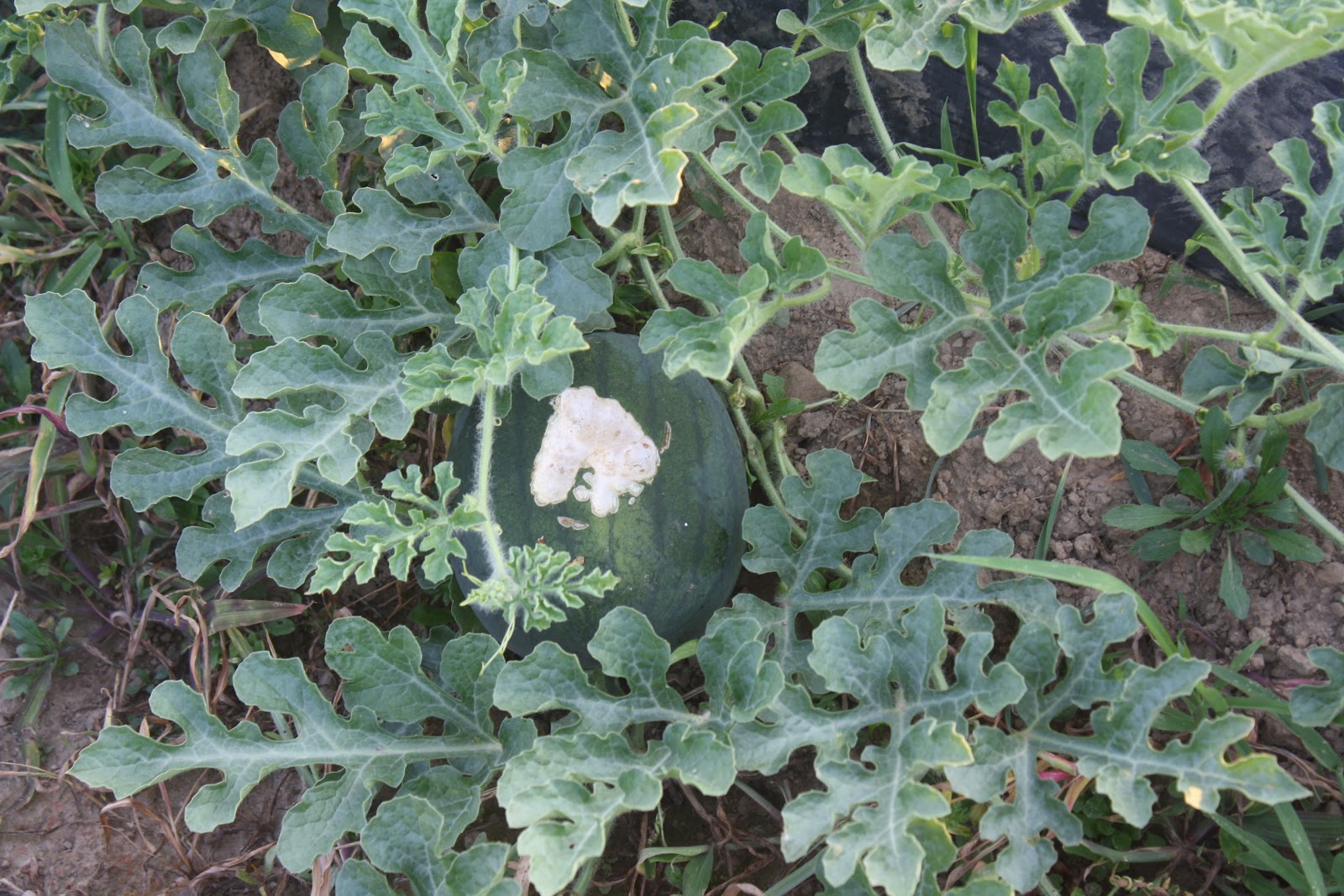
Because of the heat, this should be a good year for melons. We re growing smaller "Sugar Baby" melons. The smaller melons are the most practical ones to grow in our climate because melons need lots of long, hot days to grow. We usually  don't have as many of those days as the bigger melons need. This year has been very different, though! We wish we knew that back during the cold month of April!

We've seen some deer nibbles on our melons, but a bigger concern is crows. Some growers encounter serious trouble with crows in watermelons, and not much can be done in terms of control. They wait until they are just ready to be harvested and then start pecking away. We have seen some crows in the field -- we're just hoping they aren't savvy ones!
We're starting to see baby peppers. We're still weeks from being able to harvest them.
Pattypan squash -- two colors of them -- look good, and should be ready next week.

Summer squash and zucchini will continue next week.
We've planted sunflowers for our members to enjoy. We have just one in bloom right now. It looks a little lonely.
A lot of people have been asking about tomatoes. We understand -- we love them too! They are coming along but are still a few weeks away from being ripe.