

Wednesday, January 30, 2013
CSA Member BBQ Dates

Thursday, January 10, 2013
Sneak Peek: Garlic!
 |
| Mary Pat, Claire and Amy planted garlic early in November. |
If you haven't had garlic scapes before, they are delicious! Garlic scape pesto is probably the most popular use for garlic -- there are quite a few good scape recipes floating
around on the internet. You may want to bookmark a few possibilities for spring! Another alternative is to boil the scapes
for just a couple minutes then sautee them as you would asparagus. They
are quite tasty like that too.
Some interesting tidbits about garlic:
 | |
| We planted under plastic to control weeds. |
~ Garlic is a super food that supports digestive health, heart health, and boosts the immune system all at the same time.
~
Although it is common to see minced garlic packed in oil at the grocery
store, that is not a safe way to store garlic at home. The
oil provides an ideal growing environment for contaminants like
botulism.
- Garlic is best stored with the bulb intact, in a cool and dry place with little sunlight. Claire, our chief grower, puts her garlic in large brown-paper bags and store them through the winter in her downstairs laundry room.
- Garlic is best stored with the bulb intact, in a cool and dry place with little sunlight. Claire, our chief grower, puts her garlic in large brown-paper bags and store them through the winter in her downstairs laundry room.
~ The variety that we've planted at the farm are all
hard-neck varieties. The benefits to hard-necks are that they make
scapes (so it's like getting 2 crops from one plant), They also typically
have a better flavor and aroma. The only down side to hard neck
varieties is that they generally have a reduced storage life compared to
soft-neck varieties. Properly stored, they should be good until December or so.
Tuesday, December 4, 2012
Our story of 2012
This was given to the Wickham Family as a gift from several staff members. (It takes a minute or so to load.)
Build your own high-quality photo books at Shutterfly.com.
Sunday, August 12, 2012
Odds and Ends Dinner Pancake

1 medium onion, diced
2 small heads of broccoli, cut into very small pieces
3 leaves of kale, ribs removed and roughly chopped
2 carrots, diced
2 tbs olive oil, plus more for the pan
1 cup corn meal
3/4 cup whole spelt flour (or any whole grain)
3 eggs
1/2 cup chicken stock
Salt and pepper to taste
Over medium heat, sauteé the carrots, kale, broccoli, and onion in the 2 Tbs olive oil for about 7 minutes, until softened a bit.
Mix the sauteed veggies with all the other ingredients in a mixing bowl, it should be the consistency of pancake batter (plus veggies, of course).
Heat the extra oil over medium high heat in a non-stick pan, use just enough oil to coat the surface of the pan, and gently pan fry 3/4 cup of batter at a time. Allow to cook on one side undisturbed for 4 minutes, flip and cook for an additional 3 minutes.
We ate them warm over a bed of baby spinach, with a spicy pepper sauce on top. Very yummy and versatile!
1 cup corn meal
3/4 cup whole spelt flour (or any whole grain)
3 eggs
1/2 cup chicken stock
Salt and pepper to taste
Over medium heat, sauteé the carrots, kale, broccoli, and onion in the 2 Tbs olive oil for about 7 minutes, until softened a bit.
Mix the sauteed veggies with all the other ingredients in a mixing bowl, it should be the consistency of pancake batter (plus veggies, of course).
Heat the extra oil over medium high heat in a non-stick pan, use just enough oil to coat the surface of the pan, and gently pan fry 3/4 cup of batter at a time. Allow to cook on one side undisturbed for 4 minutes, flip and cook for an additional 3 minutes.
We ate them warm over a bed of baby spinach, with a spicy pepper sauce on top. Very yummy and versatile!
Friday, July 13, 2012
What's growing this week...
 |
| We harvested the first of our green beans this week. Yellow beans aren't far behind. |
 |
| We're seeing a lot of deer damage to our beans. See all those sticks pointing straight up? They should have flowers and/or beans on them. The deer aren't killing the plants but they are reducing and delaying the harvest. |
 |
| Beets are looking great! We will most likely harvest and distribute next week. |
 |
| We've planted a lot of broccoli. We distributed our first of it this week. It will likely continue next week (and beyond). |
 |
| Broccoli is interesting because plant produces one large primary head. On this one, where you see the grayish cut, the primary head has been harvested. Then, we get more shoots, which are smaller. Some people prefer the smaller shoots because their stems are not as thick. |
 |
| Cheddar cauliflower seems to be coming along well -- so far. Cauliflower is temperamental, which is why a lot of local CSAs don't grow it. It prefers consistently cool temperatures, which is why almost three fourths of commercial cauliflower is grown in the coastal valleys of California. The other disadvantage is that one plant produces only one head, unlike broccoli. We are giving it our best shot, though, because we know a lot of people like it. |
 |
| Concord grapes look beautiful so far. Because these vines have not been pruned for years, we are not sure how productive they'll be and how much we'll be able to offer our CSA members. |
 |
| Because of the heat, this should be a good year for melons. We re growing smaller "Sugar Baby" melons. The smaller melons are the most practical ones to grow in our climate because melons need lots of long, hot days to grow. We usually don't have as many of those days as the bigger melons need. This year has been very different, though! We wish we knew that back during the cold month of April! |
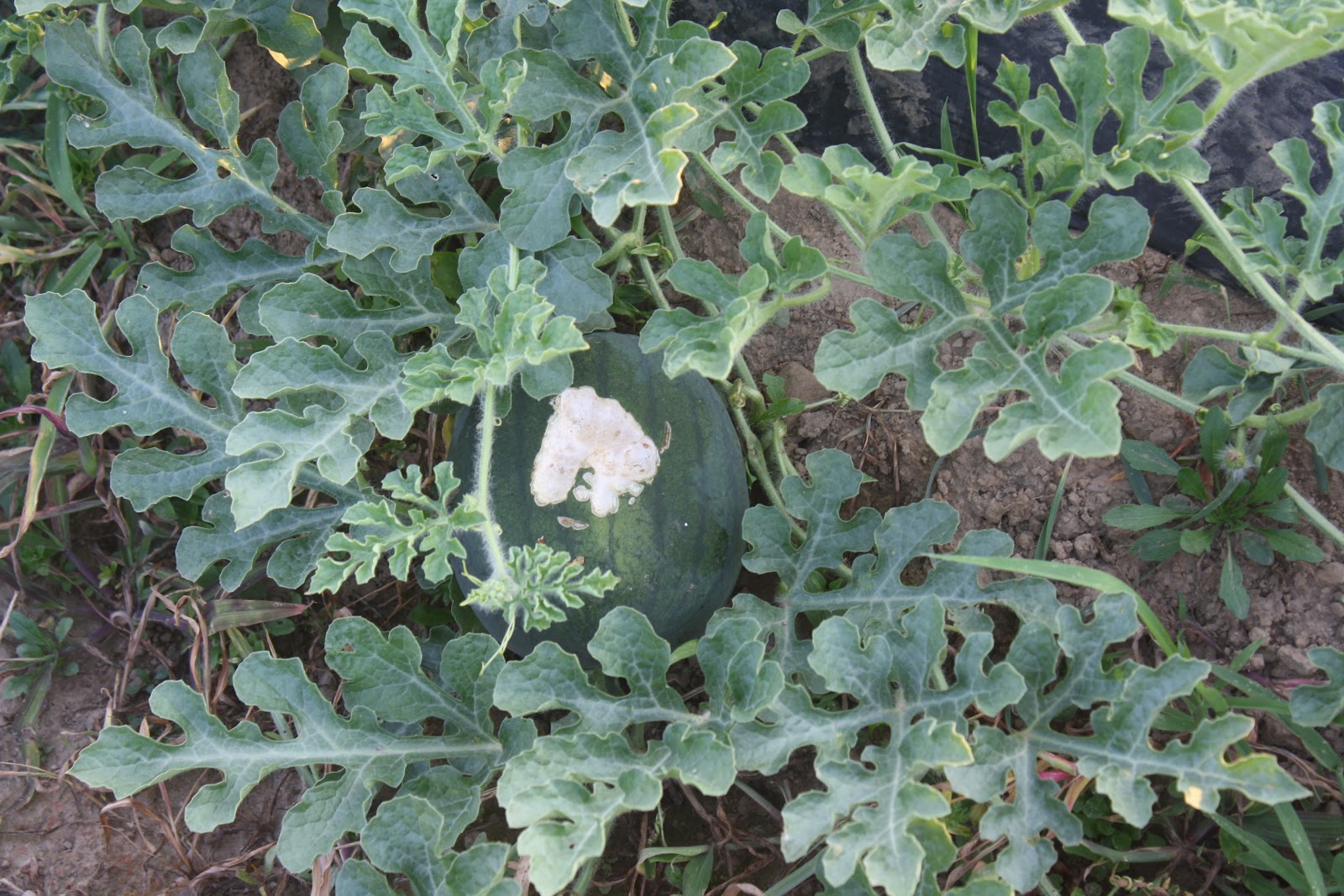 |
| We've seen some deer nibbles on our melons, but a bigger concern is crows. Some growers encounter serious trouble with crows in watermelons, and not much can be done in terms of control. They wait until they are just ready to be harvested and then start pecking away. We have seen some crows in the field -- we're just hoping they aren't savvy ones! |
 |
| We're starting to see baby peppers. We're still weeks from being able to harvest them. |
 |
| Pattypan squash -- two colors of them -- look good, and should be ready next week. |
 |
| Summer squash and zucchini will continue next week. |
 |
| We've planted sunflowers for our members to enjoy. We have just one in bloom right now. It looks a little lonely. |
 |
| A lot of people have been asking about tomatoes. We understand -- we love them too! They are coming along but are still a few weeks away from being ripe. |
Wednesday, July 11, 2012
Shares, weeks 1-5
WHEW!!! We've survived four weeks of harvesting and distribution, and we've entered week five. It's hard to believe that we're almost a quarter of the way through the CSA. We're getting a lot of positive feedback and constructive suggestions, and we've already made a number of adjustments along the way. Here's a quick recap of weeks one through five.
 | |
| Week 1 was, as expected, a fairly small harvest as we're just beginning to harvest. It included some beautiful tender lettuces, kale, mizuna, radishes, spinach and rainbow Swiss chard. Some hungry deer made our sugar snap peas a bit later than expected, but everyone got a handful -- enough to nibble on the way home! |
 |
| Week 2: Everyone was excited to see plentiful snow peas! They are definitely popular among our members. We also harvested our first arugula and red Russian kale. In addition, we had various lettuces, mizuna, radishes, spinach and spring onions. We swapped with another local farmer who uses a high tunnel farming technique to get some early zucchini and squash. We also started to cut some herbs and wildflowers. People with cats especially enjoyed the catnip! |
 | ||
| Week 3 brought our first harvest of kohlrabi! It was a first-time veggie for a lot of members. Early-season greens continued; to avoid palate fatigue, we allowed members to weigh (1.75 pounds -- that's a lot of greens) their choice of greens from arugula, tatsoi, mizuna, kale and red kale. Leaf lettuce greens continued, as did snap and snow peas. |
 |
| In week 4, we continued to offer a choice of greens, including arugula, tatsoi, mizuna, kale and red kale. Leaf lettuce continued, as did sugar snap peas, snow peas, kohlrabi and radishes. We also offered yellow squash, which was not harvested in time to make our picture. |
 |
| Week 5 began the transition to some of our popular summer crops -- broccoli, green beans and cabbage! We also had zucchini, yellow squash and the tail end of snow peas. We had three kinds of lettuce to choose from (2 heads total). Our choices of cooking greens continued, with a choice from arugula, tatsoi, mizuna, kale, red Russian kale, and Swiss chard. Our herbs really came on this week, with several available for cutting. |
Saturday, June 9, 2012
Harvest Pick-up Begins Monday!
We are so excited to start harvesting! Our member pick-up begins on Monday. Here's a sneak peak of what's coming.
If you haven't received your email with your pick-up dates and times, please contact us at the farm as soon as possible!
 | |
| Kale |
 | |
| Radishes -- these are Easter Egg radishes. See how they are shaped like Easter eggs? |
 | |
| Lettuces will be small "baby" lettuce. |
 |
| Rainbow Chard |
 |
| More baby lettuces |
 |
| Spinach. Use the small "baby" leaves for salads. Use the larger leaves in cooking. |
 |
| Mizuna. You can use this raw or cooked. |
Subscribe to:
Posts (Atom)